A pencil and a piece of paper are the cheapest game set in the world. They fit in a pocket, they work at a restaurant table or on a long car ride, and they never run out of batteries. Many of the best pencil and paper games have been played for generations because they are quick to learn and surprisingly deep. This guide covers twelve of them, sorted from the simplest to the most strategic, with the age each one suits and a tip that makes it more fun.
Why pencil and paper games are worth teaching
Pencil and paper games are perfect for families because they ask for almost nothing. There is no setup, no box to lose, and no pieces for a toddler to swallow. They also sneak in real skills. Tic-Tac-Toe teaches children to look for a threat before it happens. Hangman practices spelling. Dots and Boxes rewards counting ahead. Most games last two to ten minutes, so they fill short gaps in the day without turning into a big event.
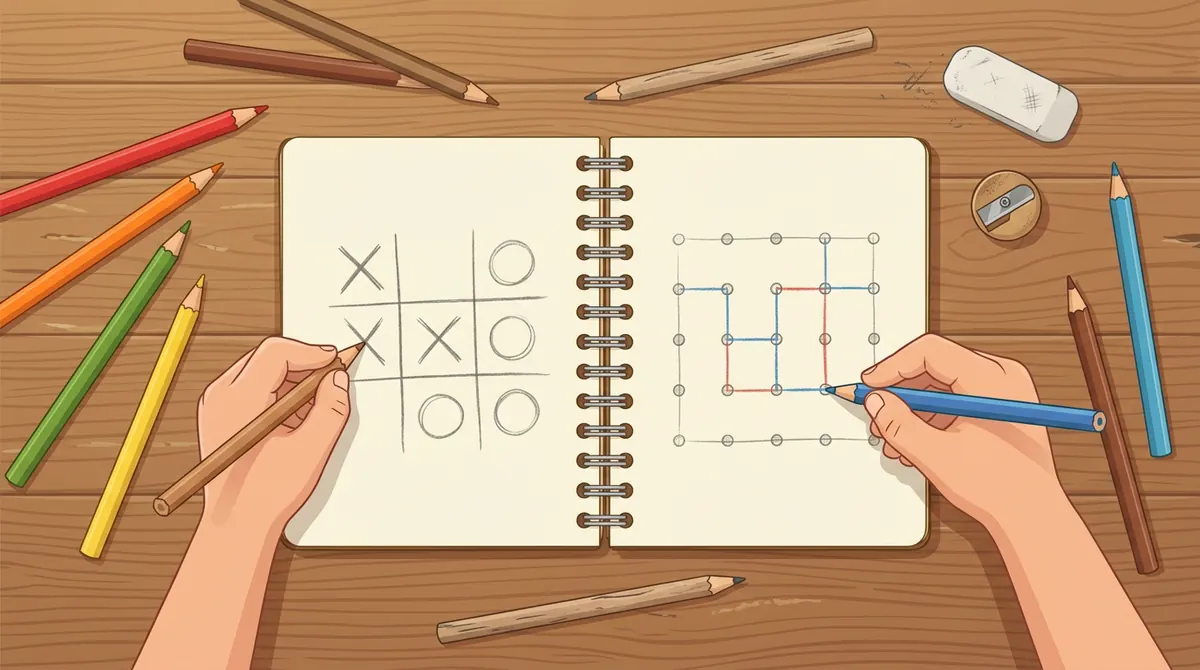
Keep a small notebook and two pencils in your bag or glove box. That is your travel game kit sorted.
Quick games for younger kids (ages 4 to 7)
1. Tic-Tac-Toe
Draw a three-by-three grid. Players take turns writing X or O in an empty square, and the first to get three in a row across, down or diagonally wins. Young children learn to block, and older children discover that two careful players always tie. When that happens, it is time to move up to Gomoku. See the full [Tic-Tac-Toe rules](/games/tic-tac-toe) for winning patterns to teach.
2. Squiggle drawing
One player draws a random squiggle. The other turns it into a picture: a fish, a monster, a hat. There is no winner, which makes it great for the youngest players and for siblings who argue. Swap roles every turn.
3. Hot and cold drawing
One player thinks of a simple object and starts drawing it one line at a time. The other guesses after every line. The fewer lines it takes, the better the drawer did. It is a gentle introduction to drawing-and-guessing games like [Pictionary](/games/pictionary).
4. Hangman
One player thinks of a word and draws a blank for each letter. The other guesses letters one at a time. Correct letters fill the blanks; wrong guesses add a part to a simple drawing. Many families swap the traditional drawing for a snowman, a flower or a spider to keep it friendly. Pick short words for early readers. More tips are in our [Hangman guide](/games/hangman).
Thinking games for ages 7 and up
5. Dots and Boxes
Draw a grid of dots, such as five by five. Players take turns joining two neighboring dots with a line. If your line completes a box, write your initial inside and take another turn. The player with the most boxes at the end wins. The secret is to avoid drawing the third side of a box, because that hands your opponent a free point. Learn the chain strategy in our [Dots and Boxes rules](/games/dots-and-boxes).
6. Battleship on paper
Each player draws two ten-by-ten grids labeled A to J across and 1 to 10 down. Secretly mark your ships on one grid: one five-square ship, one four, two threes and one two. Take turns calling squares, like "C7". The other player says hit or miss, and you track your shots on your second grid. The first to sink every ship wins. See our [Battleship guide](/games/battleship) for smarter search patterns.
7. Categories
Choose five categories, such as animals, foods, countries, names and things in a kitchen. Pick a letter, then race to write one answer for each category that starts with that letter. Score a point for each answer no one else wrote. It is a homemade version of [Scattergories](/games/scattergories) and works for any number of players.
8. Word ladders
Write a start word and an end word with the same number of letters, such as CAT and DOG. Change one letter at a time to make a new real word at every step: CAT, COT, COG, DOG. Players race to finish the ladder, or try to do it in the fewest steps. It is a calm game that quietly builds spelling.
Strategy games for older kids and adults
9. Gomoku (five in a row)
Draw a large grid, or use graph paper. Players take turns marking X and O at line crossings, and the first to make an unbroken line of five wins. It feels like Tic-Tac-Toe at first, but the bigger board makes it a real strategy game. Read the [Gomoku rules](/games/gomoku).
10. Sprouts
Draw three dots. On your turn, draw a line that joins two dots, or loops from a dot back to itself, then put a new dot in the middle of your line. Lines cannot cross, and a dot can have no more than three lines touching it. The last player able to move wins. Sprouts was invented by two mathematicians at Cambridge in the 1960s, and it is still studied today.
11. Paper boxes race (Squares)
Use graph paper. Players take turns shading one square. Whoever completes a two-by-two block in their own color scores a point. It is simple to explain and leads to surprisingly clever blocking.
12. Paper football
Fold a strip of paper into a small triangle and flick it across a table toward your opponent's edge. It is not strictly pencil and paper, but it uses one sheet of paper and keeps restless kids busy. Our [paper football guide](/games/paper-football) explains scoring and field goals.
Choosing the right game
| Game | Best ages | Players | Time |
|---|---|---|---|
| Tic-Tac-Toe | 4+ | 2 | 1–2 minutes |
| Hangman | 6+ | 2+ | 3–5 minutes |
| Dots and Boxes | 6+ | 2 | 5–10 minutes |
| Battleship | 7+ | 2 | 15–25 minutes |
| Categories | 8+ | 2–8 | 5 minutes per round |
| Word ladders | 8+ | 1+ | 5 minutes |
| Gomoku | 8+ | 2 | 5–15 minutes |
| Sprouts | 9+ | 2 | 5–10 minutes |
Tips for playing with mixed ages
- Pair up. A young child can team with an older sibling in Battleship or Categories.
- Give a head start. In Dots and Boxes, let a younger player start with two boxes already won.
- Use pictures. Non-readers can play Categories by drawing instead of writing.
- Keep scores light. For short games, play best of three, then switch games before anyone gets bored.
Pencil and paper games FAQ
What is the easiest pencil and paper game for young children?
Tic-Tac-Toe and squiggle drawing are the easiest. Both take seconds to explain, and squiggle drawing has no winner or loser, which suits children around age four.
What pencil and paper games are good for two players?
Tic-Tac-Toe, Dots and Boxes, Battleship, Gomoku and Sprouts are all built for two players and work well at a table or on a lap.
Which paper games work for a group?
Categories, word ladders and drawing-and-guessing games work for groups. Each player only needs their own pencil and paper.
Are pencil and paper games good for learning?
Yes. Hangman and word ladders practice spelling, Categories builds vocabulary, and Dots and Boxes and Gomoku teach children to plan ahead and spot patterns.
How can I make Hangman less scary for little kids?
Replace the hanging figure with a snowman, a flower or a smiley face that gains a part with each wrong guess. The game works exactly the same way.